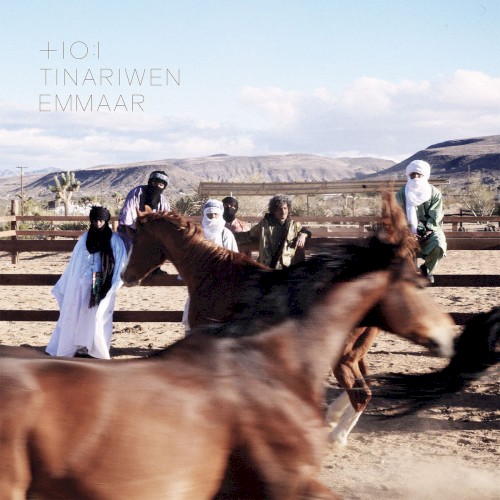

Emmaar - the Tamasheq word for a type of desert tree - was born out of displacement. Tinariwen, the Tuareg guitar group from northern Mali, were unable to record in their homeland due to the ongoing conflict in the Sahel region. Instead, they decamped to Joshua Tree, California, finding in the American desert a landscape that echoed, if imperfectly, the vast open spaces of their native Sahara. The displacement is audible in the music - there is a longing in these songs, a reaching toward home, that gives the album an emotional urgency that deepens its musical impact.
The guitar playing is, as always, Tinariwen's primary strength. Ibrahim Ag Alhabib, Abdallah Ag Alhousseyni, and their bandmates play interlocking electric guitar patterns that draw from Tuareg musical traditions - repetitive, hypnotic figures built on pentatonic scales that create a drone-like effect similar to the music of the West African griot tradition. But on Emmaar, these patterns are given a slightly more polished production treatment than on earlier albums, the guitars ringing with a clarity that emphasises their melodic beauty without sacrificing the raw, improvisational energy that defines Tinariwen's live performances.
The rhythmic foundation is built on call-and-response patterns that reflect the communal nature of Tuareg musical practice. Percussion parts interlock with a looseness that feels organic and spontaneous, each musician contributing to a collective groove rather than following a predetermined arrangement. The handclaps and chanting that punctuate tracks like "Toumast Tincha" transform the recording from a studio production into something that feels like a communal gathering, a musical conversation among people who share a deep cultural bond.
Guest contributions from Tunde Adebimpe and Fats Kaplin, among others, add textural variety without disrupting the album's essential character. The Joshua Tree recording location brings a different kind of spaciousness to the sound - the reverb tails are longer, the stereo image wider, giving the music a sense of physical scale that suits its emotional expansiveness.
Emmaar is not Tinariwen's most challenging or most innovative record, but it may be their most emotionally direct. The theme of exile and homecoming runs through every track, and the music - at once ancient and contemporary, rooted and rootless - gives that theme a sonic embodiment that words alone could not achieve. It is a reminder that the greatest music emerges from the intersection of tradition and necessity.