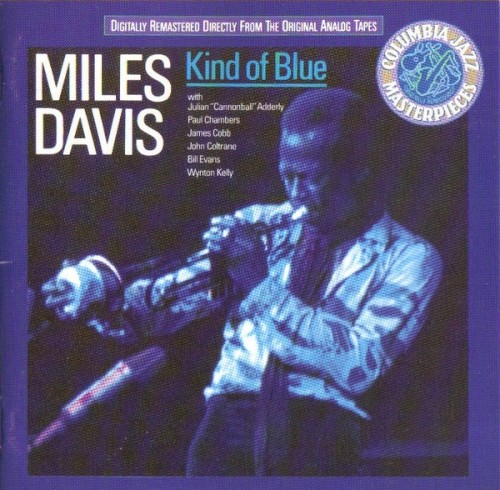

Kind of Blue exists in a space beyond criticism. To review it is like reviewing the sunrise - you can describe what you see, you can analyse the physics of light refraction, but ultimately you are in the presence of something that simply is. Miles Davis walked into Columbia's 30th Street Studio on two days in the spring of 1959 with a set of modal sketches and a band of extraordinary musicians, and what they created in those sessions has never been equalled.
The album's genius lies in its restraint. Davis had grown tired of the harmonic complexity of bebop - the endless chord changes, the emphasis on technical virtuosity - and sought something more spacious, more contemplative. The modal approach he pioneered here uses scales rather than chord progressions as the harmonic foundation, freeing the soloists to explore melody and mood rather than navigating a maze of changes. The result is music that breathes - long, unhurried phrases that float above Bill Evans's shimmering piano voicings like birds above a still lake.
The band is a once-in-a-lifetime assembly. John Coltrane's tenor saxophone on "So What" is muscular and searching, pushing against the modal framework with an intensity that previews the spiritual explorations of his later work. Cannonball Adderley's alto provides the perfect complement - bluesy, warm, and rhythmically grounded where Coltrane is angular and questing. Evans's piano - particularly the gossamer voicings on "Blue in Green" - provides the harmonic colour that gives each piece its distinctive emotional temperature.
Paul Chambers's bass work is the album's foundation. His walking lines on "Freddie Freeloader" are so melodically rich that they constitute a counterpoint to the soloists rather than mere accompaniment. Jimmy Cobb's brushwork on "Flamenco Sketches" is so delicate, so perfectly attuned to the music's glacial pace, that you might forget the drums are there at all - until they stop, and you realise how essential they were.
Kind of Blue teaches us that the most profound statements are often the simplest. It is an album that values space above notes, feeling above technique, and beauty above all else. Every musician who has ever picked up an instrument owes it a debt, and every listener who encounters it for the first time is about to have their understanding of what music can be permanently expanded.