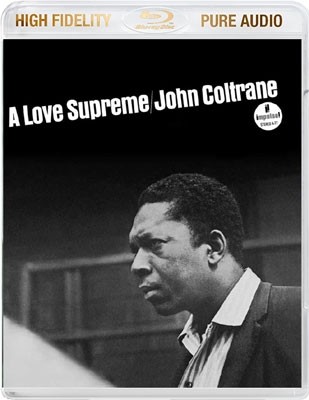

A Love Supreme is a prayer made audible. Recorded in a single session in December 1964, John Coltrane's four-part suite is simultaneously the culmination of his musical journey to that point and a doorway into the spiritual explorations that would consume the final years of his life. It is an album of extraordinary intensity and extraordinary tenderness, and it communicates something that exists beyond the reach of language.
The opening "Acknowledgement" begins with a crash of cymbals and a bass figure from Jimmy Garrison that ascends like a supplication. Then Coltrane enters, and the four-note motif that will define the entire suite - the phrase that Coltrane later chants as "a love supreme" - unfolds with a simplicity and directness that belies the complexity of what follows. He repeats the motif in every key, transposing it through the full chromatic spectrum as if searching for the one iteration that will crack open the heavens. It is a musical act of devotion so pure that it transcends its religious origins and becomes universal.
McCoy Tyner's piano is the harmonic bedrock. His voicings - dense, quartal chords that shimmer with overtones - create a foundation that is both stable and shimmering, grounding Coltrane's increasingly free explorations in something solid and warm. On "Resolution," his comping drives the quartet forward with a rhythmic intensity that matches Coltrane's most passionate playing, the two musicians locked in a dialogue that seems to generate its own energy.
Elvin Jones's drumming is among the most remarkable in recorded music. His polyrhythmic approach - simultaneously playing in and against the time, creating patterns of staggering complexity that somehow maintain a propulsive swing - is the engine that drives the suite's emotional arc. On "Pursuance," his extended drum solo builds from whispered brushwork to thunderous rolls with an architectural logic that mirrors the suite's larger structure.
"Psalm," the final movement, is Coltrane playing his own poem as a melody - each phrase of the written text corresponding to a musical phrase played on his saxophone. It is one of the most intimate moments in recorded music, the sound of a man speaking directly to God through his instrument. A Love Supreme reminds us that music, at its highest, is an act of spiritual communion - between musicians, between performer and listener, between the human and the divine.